


Now Publishing New Content Every Weekend
Could this time of Transition be an opportunity for Reconsideration and Renewal within our Churches?
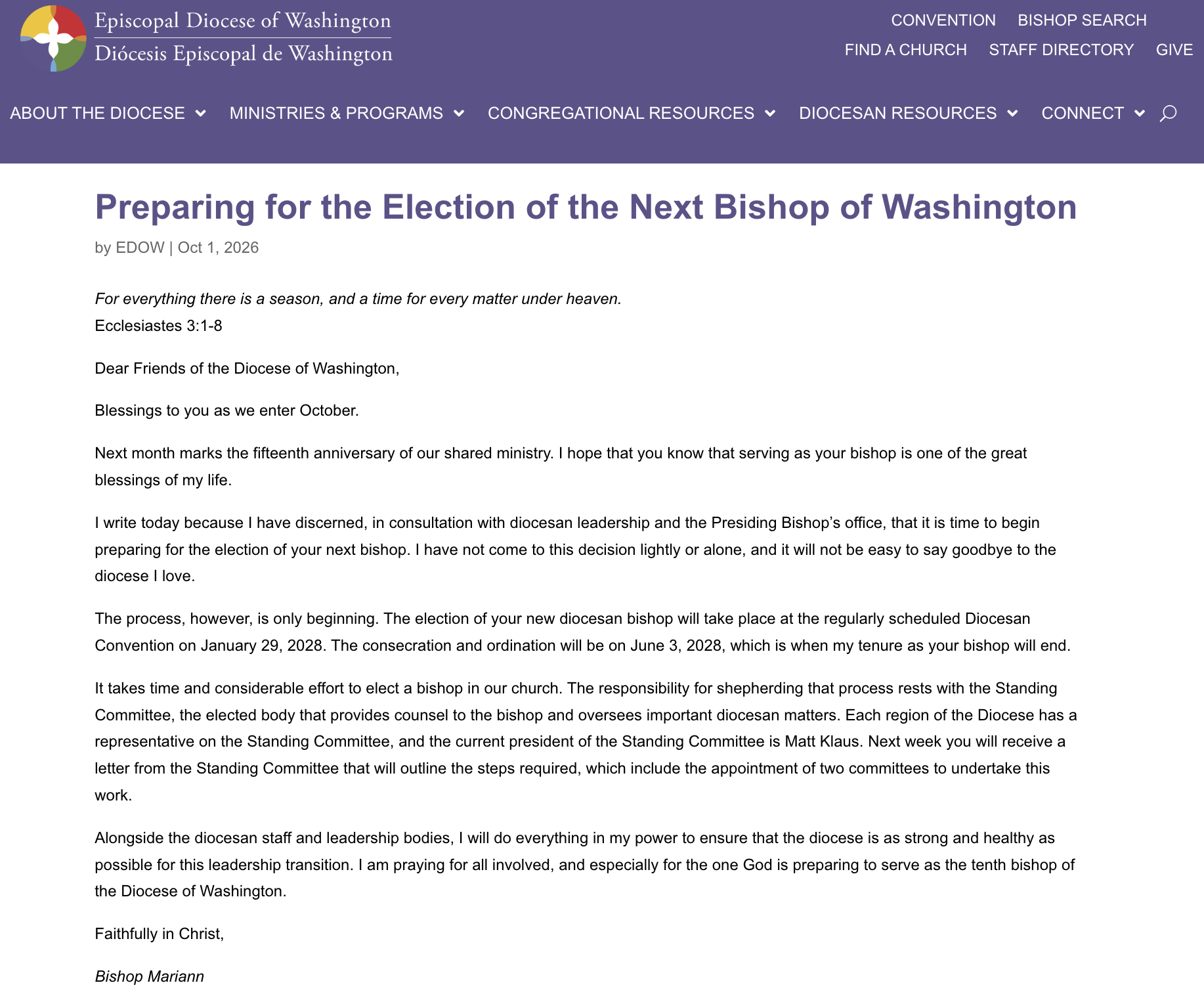
The Right Reverend Mariann Edgar Budde, Bishop for the Episcopal Diocese of Washington announced her upcoming resignation. She notes her desire to “ensure there’s as much wind in the sails for the future leader and the diocese going forward as is humanly possible.” That’s a nice maritime image of administrative readiness, but for a Church whose membership is bipartisan and diverse, whose leadership allegedly crosses the line into political activism, and which does not include God’s Seven Spirits when discussing God’s Holy Spirit, it sometimes feels like a diocese sailing against the wind. The question becomes: What will the “source be” for all the wind in the sails of the next Bishop? Is “introspective spiritual growth” a possibility?
Diocesan structures evolve and search committees will find the next Bishop but “true Spiritual renewal” cannot be engineered through institutional management alone. It requires improvements and alignment with the full power of the Holy Spirit which is operated by the Seven Spirits of God, whose names are Knowledge, Understanding, Wisdom, our Lord Jesus Christ, Counsel, Might, and reverent Fear of our Lord.
While the historic church has spent centuries guarding institutional sails through the structured, text-bound summaries of the Nicene and Apostles’ Creeds, we have inadvertently minimized the very operating system that powers the Church. As the Diocese of Washington prepares for a transition of leadership, it is time for the Church at large to move beyond a purely theoretical understanding of God’s presence and step into the expansive, experiential reality of God’s Seven Spirits.
Two Ways of Knowing: Travel Agent Brochure vs. The Actual Destination
To understand why the church struggles to talk about this reality, we must distinguish between two different types of knowledge: “propositional” knowledge and “experiential” knowledge.
Propositional is based on texts, history, and doctrines. It is an intellectual understanding of what has been recorded and agreed upon in councils. For most clergy, this is a knowledge based on faith and academic study, rather than direct encounters.
Experiential by contrast, is gained through direct, personal encounters.
Imagine you are planning a trip to Hawaii. To prepare, you visit a travel agent. The agent has studied maps of the islands, memorized hotel brochures, and read extensively about the history and climate. They can give you an official, structured itinerary based on the data available to them. However, that agent has never actually set foot on the islands.
Now, imagine speaking with someone who has just returned from living in Hawaii. This person can tell you how the air smells, the exact shade of the ocean at sunset, and specific details about the landscape that never made it into the brochures. The travel agent’s knowledge is accurate according to their text, but it is fundamentally limited compared to the living reality of the person who was there. In the same way, traditional doctrinal study provides a map, but it cannot replace the direct experience of the destination. This gap between a travel agent’s brochure – and having personally visited the destination – is precisely where the Church’s current teaching falls short. Relying solely on propositional knowledge, clergy can only hand their congregations a map – the simplified summaries of the creeds.
Liturgical Proof of What We Pray, but Do Not Preach
But when we look at the actual practices of the Church, we find that the liturgy itself is quietly begging us to look at the destination. We do not merely read about the journey; we actively pray for the reality of it every time we gather for our most sacred milestones.
To find the missing architecture of our pneumatology, Episcopal clergy need not look further than their own desks. Open the Book of Common Prayer to the Confirmation rite (p. 418). When a bishop lays hands upon a candidate, the formal prayer invoked over their life is not a recitation of the Nicene formula. Instead, it is an explicit plea for the sevenfold manifestation of the Holy Spirit:
“Sustain them, O Lord, with your Holy Spirit. Give them an inquiring and discerning heart the courage to will and to persevere, a spirit to know and to love you, and the gift of joy and wonder in all your works.”
This prayer – deeply rooted in the traditional translation of Isaiah 11:2 – is the primary liturgical proof that the Episcopal Church already recognizes the multifaceted operation of the Holy Spirit at a foundational sacramental level. Every time a bishop performs a confirmation, they are calling down these specific facets of the divine character.
Why then, does our Sunday preaching treat the Holy Spirit as a vague, singular influence, while ignoring the precise “operating system” we textually invoke during our most sacred milestones? By confining our teaching strictly to the brief summaries of the early creeds, clergy are operating with a non-experiential, propositional knowledge. They are treating the Confirmation prayer as a traditional poetic formula rather than a description of a living, accessible reality. If we are to honor the liturgy we practice, we must bridge the gap between the book’s text and the experiential reality of the sevenfold Spirit it describes.
The Divine Architecture of Isaiah, Revelation, and the Sevenfold Operating System of God’s Holy Spirit
To understand why the Seven Spirits are critical to the life of the Church, it is helpful to look at them through a modern lens: the Seven Spirits are the operating system (OS) of the Holy Spirit.
In sacred Scripture, this architecture is revealed in two distinct movements: the promise of the system’s capabilities, and a live view of it running before the Throne. In Isaiah 11:2, the prophet details the foundational programming of this OS, mapping out its core subroutines: Knowledge; Understanding; Wisdom; our Lord Jesus Christ; Counsel, Might, and the reverent Fear of our Lord – all resting upon the Messiah. Centuries later, the Apostle John is given an experiential, first-hand view of this system fully active in heaven, describing “seven lamps of fire burning before the throne, which are the Seven Spirits of God” (Revelation 4:5).
Clergy, relying on text-bound, propositional knowledge, often glance at these passages and dismiss them as obscure, purely symbolic imagery – like a decorative seven-flamed candelabra. But those who have experienced the reality beyond human limitations see a far more profound, energetic architecture. The true nature of these Spirits is not static symbolism; they are seven massive stars of nuclear fusion burning side-by-side, shaped as vertical columns, pillars of fire rushing upward.
An operating system is not separate from the computer, it is the vital mechanism through which the system executes commands and brings a blank screen to life. The Holy Spirit of Jesus Christ is the divine presence, and the Seven Spirits are the operational facets – the massive, burning pillars of divine character – through which that presence executes God’s will on earth. When clergy refuse to teach this because it extends past the margins of the Nicene Creed, they are trying to run a 21st-century church on an inefficient system, mistaking the instruction manual (the creeds) for the living software itself (the Seven Spirits of God’s Holy Spirit of Jesus Christ).
Addressing the Hesitancy of Clergy
It is entirely understandable why clergy might hesitate when asked to look beyond the precise wording of the Nicene and Apostles’ Creeds. Bishops, priests, and deacons are explicitly vowed to guard the traditional deposit of faith and protect their congregations from theological drift. When confronted with experiential details that exceed the standard formulas, the instinctual pastoral response is often one of caution, viewing the information as an unnecessary or even risky innovation.
However, exploring the fullness of the Seven Spirits is not an innovation; it is a restoration. Clergy can rest assured that this perspective does not contradict holy Scripture, nor does it challenge the orthodox understanding of the Trinity. Instead, it directly honors the text of the Bible, where the Seven Spirits are explicitly named in both the Old and New Testaments.
The early creeds were never intended to be exhaustive encyclopedias containing every biblical detail; they were concise, protective summaries designed to be a reference for the spread of Christianity. By mistaking a summary for a boundary, the Church has inadvertently fenced off major portions of its own canonical text. Embracing the sevenfold operational reality of the Holy Spirit does not undermine the creeds – it simply unlocks the full scriptural depth that the creeds were built to protect.
A Call to the Leadership of Churches Worldwide
As the Diocese of Washington enters this pivotal season of transition, seeking the “wind in the sails” for its next era of ministry, the Church stands at a profound crossroads. Institutional restructuring, strategic planning, and administrative readiness are necessary tools, but they are entirely secondary to the true source of spiritual power. The Church cannot navigate the complex challenges of a modern world by relying solely on a propositional, “travel-agent” understanding of God’s presence.
The call before the new leadership of the Diocese of Washington – and indeed, before the entire Christian clergy worldwide – is to transition from theory to experience. It is a call to align the Church’s preaching with its existing liturgy, bringing the foundational reality of the Seven Spirits out from the quiet margins of the Confirmation rite and into the center of standard Christian teaching.
By restoring the worthy magnification of these seven operational facets of God’s presence, the next Bishop of Washington can give the diocese much more than just steady administrative oversight. They can get the wind in their sails from the true power of the Holy Spirit. Allowing the seven massive burning stars at God’s Throne to fuel a genuine spiritual renewal that reaches far beyond the Episcopal Diocese of Washington, DC.
About the Author: John Levay is a momentary-death survivor and founder of There You Are Jesus .com, a platform dedicated to sharing evidence of modern-day interactions with God – ranging from direct and irrefutable – to circumstantial and coincidental that occur with too much timing, relevance, and repetition to ignore. Following a life-changing medical resuscitation, John was left with precise, firsthand memories of the Throne of God and the bold, majestic architecture of God’s Seven Spirits. Rather than challenging the Church or contradicting Scripture, John writes as a grateful messenger whose core mission is to: (1) Deliver the message he was given by his grandfather, George Quirk, about the Seven Spirits at God’s Throne; and (2) Help Clergy, Laypeople, Believers, and Non-Believers recover the “operational depth” of God’s Holy Spirit. He prayerfully invites people of all beliefs to explore the evidence on his website, ThereYouAreJesus.com. You can contact him by personal email, john@thereyouarejesus.com.
In a related story Sean Hannity airs concerns about Pope Leo XIV Head of the Catholic Church Click here to watch
The following four links are to our main categories of evidence – Each contains numerous posts
This next series of links are to some of the essentials about ThereYouAreJesus.com
The number 7 is sometimes referred to as “God’s Number.” Seven days in a week, seven colors in a rainbow, seven continents on earth, and so much more. 7 appears 57 times in the Book of Revelation and that’s just 1 of 66 Books in the Bible. What would we discover if we started at the very beginning of the Bible and followed God’s favorite number all the way through to the end, book by book, from Genesis to Revelation? This is a new and original series on ThereYouAreJesus.com, called The Biblical Trail of Sevens – this links to the Series Preview.
If you would like to understand the complete biblical and personal foundation for our Mission, please read: Restoring the Seven Spirits of God’s Holy Spirit of Jesus Christ into Mainstream Christianity. There I explain in greater detail what we are asking Christians and Church Leaders to consider, and why.
This next link is a dedication to Bishop Mariann Budde. We see things differently about Fear of God and Not having any Fear. This article explains how we both can be right… Understanding the Difference between Fear of God and There is No Fear
… and while we’re at it, how about a song for such times as these …
Link to a Song Video about my Mom’s Agreement to have Bluebirds Appear when I pray to her.
Jesus told His disciples: “As the Father has sent me, I am sending you.” (John 20:21)
Praise God for everything in your life.
John Levay ✝︎ john@thereyouarejesus.com ✝︎ Now Publishing New Content Every Weekend



Thank you for visiting There You Are Jesus .com, please come see us again.

